Case Study: Can America Build a Fully Automated Hemp Textile Plant That Competes With Imports?
A feasibility analysis of reshoring textile manufacturing through industrial hemp and robotics
Published by Industrial Hemp Processing of America (IHPA)
The Problem
The United States imports over 97% of its clothing. Nearly all of it arrives from countries like Vietnam, Bangladesh, China, and India — nations where labor costs range from $0.50 to $2.00 per hour. Over the past four decades, America's textile manufacturing base has been almost entirely offshored, taking with it millions of jobs, critical supply chain infrastructure, and any semblance of domestic self-sufficiency in one of the most basic human needs: clothing.
The conventional wisdom says this is irreversible. Labor is simply too expensive in the U.S. to manufacture garments competitively. For decades, that was true.
It's not true anymore.
Two converging forces are rewriting the economics of textile manufacturing: industrial hemp fiber and robotic automation. Together, they create a viable path to cost-competitive, fully domestic textile production — from raw fiber to finished garment — on American soil.
This case study examines what it would take to build that facility, what it would cost, and why the numbers work.
The Opportunity
Hemp: A Superior Fiber Hiding in Plain Sight
Industrial hemp produces a bast fiber that, when properly processed, rivals or exceeds cotton in durability, breathability, and comfort. Hemp requires no irrigation in most climates, needs minimal pesticides, grows in a wide range of soil conditions, and sequesters an estimated 40 tons of CO₂ per acre during its growing cycle. It matures in roughly 90–120 days and fits naturally into crop rotation systems that improve soil health — making it an ideal regenerative agriculture crop.
The problem has never been the fiber. It's been the processing.
Raw hemp fiber is coarse, stiff, and incompatible with modern cotton spinning equipment. Historically, converting hemp into a spinnable, cotton-like fiber — a process called "cottonization" — was slow, chemical-intensive, and expensive. That bottleneck kept hemp textiles in the premium niche category, priced far above commodity cotton garments.
Steam explosion cottonization changes this equation entirely.
Steam Explosion: The Breakthrough
Steam explosion (SE) is a thermomechanical process that separates hemp's elementary fibers without harsh chemicals or expensive enzymes. The process is straightforward: raw hemp fiber is saturated with water, loaded into a pressure vessel, heated to approximately 190°C for about four minutes, and then the pressure is rapidly released. The sudden decompression causes an internal "explosion" within the fiber structure that separates the individual cellulose fibers from the lignin and pectin binding them together.
The result is a cotton-length fiber (20–40mm) with high cellulose content that runs on standard cotton spinning equipment — the same machines used in every cotton mill in the world.
Steam explosion uses minimal water, no harsh chemicals, produces high-quality fiber, and scales efficiently with relatively modest equipment. Batch reactors are already used at industrial scale in biomass processing. Adapting them for hemp cottonization is an engineering challenge, not a scientific one.
Automation: Erasing the Labor Advantage
The second half of the equation is automation. Sewing — the final and most labor-intensive step in garment production — has historically been impossible to automate because fabric is soft, flexible, and difficult for robots to manipulate. This is the single reason garment manufacturing chased cheap labor around the globe for decades.
That barrier is falling. Robotic sewing systems now use machine vision and lightweight robotics to guide fabric through sewing machines with greater speed and precision than human operators. These systems can produce a finished t-shirt in roughly four minutes, with labor costs per garment as low as $0.33. At that price point, the cheapest labor markets in the world cannot compete.
When you combine automated sewing with automated spinning, knitting, dyeing, cutting, and packaging — all of which are mature technologies — you get a facility that requires 80–120 workers instead of the 800+ that a conventional plant of equivalent output would need.
The Facility: What It Looks Like
We modeled a fully integrated, automated hemp textile manufacturing facility designed to receive baled hemp fiber, cottonize it on-site via steam explosion, and produce finished garments — primarily t-shirts, work pants, and workwear.
Scale and Footprint
The facility requires approximately 250,000–300,000 square feet of manufacturing space on 15–20 acres, including water treatment, warehousing, and room for future expansion. Target output is 8,000–12,000 finished garments per day.
The Six Production Zones
Zone 1 — Steam Explosion Cottonization (25,000 sq ft): Baled hemp fiber is opened, impregnated with water, processed through batch steam explosion reactors, washed, dried, and opened into spinnable fiber. This is the most novel zone in the facility and the one that transforms hemp from a raw agricultural product into a textile-ready input.
Zone 2 — Spinning (50,000 sq ft): Cottonized fiber is processed through a standard cotton spinning line — blowroom, carding, drawing, and open-end rotor spinning — to produce yarn. Open-end spinning is preferred for its speed, automation capability, and compatibility with hemp's fiber characteristics. Ring spinning capacity can be added for premium yarn counts.
Zone 3 — Fabric Formation (40,000 sq ft): Yarn is converted into fabric via circular knitting machines (for t-shirts and jersey knits) and air-jet or rapier looms (for pants, canvas, and workwear fabrics). Both technologies are highly automated and mature.
Zone 4 — Dyeing and Finishing (45,000 sq ft): Raw fabric is scoured, bleached, dyed, and finished. This is the most water- and energy-intensive zone. Modern jet dyeing machines with low liquor ratios significantly reduce water usage compared to older equipment. A dedicated wastewater treatment plant and water recycling system are essential components.
Zone 5 — Automated Cut and Sew (50,000 sq ft): Fabric is spread, pattern-cut via CNC systems, and assembled by robotic sewing lines. T-shirts are the most automation-ready product; pants and workwear use hybrid human-robot cells. Automated pressing, labeling, folding, and packaging complete the line.
Zone 6 — Warehouse and Support (40,000 sq ft): Finished goods storage, automated material handling, shipping, and plant-wide control systems (ERP, MES, SCADA) for production monitoring and optimization.
The Numbers
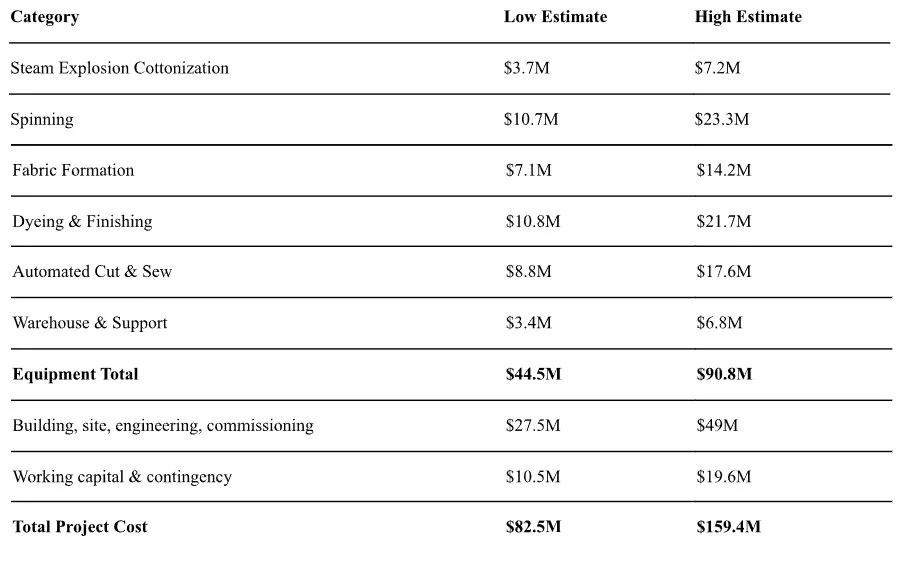
Capital Investment
Per-Garment Economics: U.S. Automated vs. Vietnamese Import
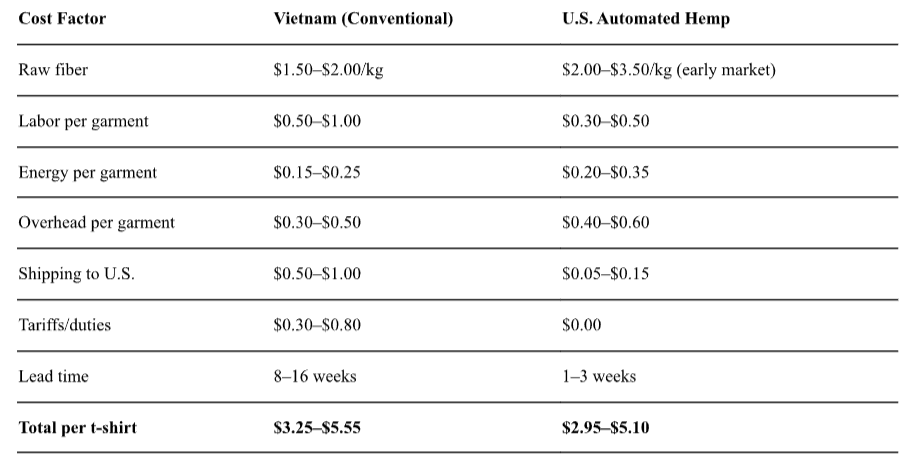
The U.S. facility is already competitive on a fully-landed cost basis. As domestic hemp fiber supply scales and raw material costs drop toward $1.50/kg, the American plant becomes decisively cheaper across all product categories.
Why This Works Now (And Didn't Before)
1. Steam explosion cottonization is proven. The science and engineering are mature. What's needed is purpose-built production-scale equipment, not fundamental research.
2. Robotic sewing has crossed the viability threshold. Machine vision and lightweight robotics can now handle soft fabric manipulation at production speeds, reducing per-garment labor costs below the cheapest overseas alternatives.
3. Trade dynamics favor reshoring. Tariffs on imported textiles, supply chain fragility exposed during COVID-19, and rising shipping costs all erode the import cost advantage. A 100% domestic supply chain eliminates trade war risk entirely.
4. Lead time is a competitive weapon. A 1–3 week turnaround versus 3–4 months from Southeast Asia enables on-demand and small-batch production models that import supply chains simply cannot support.
5. The sustainability premium is real. Hemp's regenerative agriculture profile, combined with domestic manufacturing's reduced carbon footprint, commands a 15–30% price premium in direct-to-consumer and institutional procurement channels. Military, government, and corporate uniform contracts increasingly require or prefer domestic sourcing.
6. There is no domestic competition. No facility like this currently exists in the United States. The first mover captures the market position, the brand story, and the institutional relationships.
The Phased Approach
Building a $80–160M facility all at once is unnecessary and unwise. A phased strategy de-risks the investment while generating revenue at each stage.
Phase 1 — Cottonization and Spinning ($25–35M): Build the steam explosion line and spinning mill. Sell cottonized hemp fiber and yarn to existing U.S. knitting mills, weavers, and brands. This proves the fiber quality in the market, establishes customer relationships, and generates cash flow.
Phase 2 — Fabric Formation ($20–30M): Add knitting and weaving capacity. Sell finished fabric — greige or dyed through contract dyehouses. This captures significantly more margin than selling raw yarn.
Phase 3 — Full Vertical Integration ($20–35M): Add in-house dyeing, finishing, and automated cut-and-sew. Produce finished garments under contract or house brands. Target direct-to-consumer, government procurement, military contracts, and workwear programs.
Each phase is independently viable and revenue-generating. Phase 1 can reach positive cash flow within 18–24 months of commissioning.
The Bigger Picture
This isn't just about one factory. It's about proving a model.
If a single automated hemp textile facility can produce garments at import-competitive prices on American soil, the implications cascade across the economy. It means hemp farmers have a guaranteed domestic buyer for their fiber. It means rural communities gain advanced manufacturing jobs. It means the U.S. begins rebuilding a critical supply chain capability that has been entirely offshore for a generation.
The raw materials grow in American fields. The automation technology was developed in American universities with American defense funding. The demand exists in American markets. The only missing piece is the physical infrastructure to connect them.
That infrastructure can be built. This case study demonstrates how.
About IHPA
Industrial Hemp Processing of America (IHPA) is a Washington State-based organization building the state's first dedicated industrial hemp processing facility for fiber, hurd, seed, and biochar. IHPA's mission is to create the processing infrastructure that transforms industrial hemp from a promising crop into a viable domestic industry — starting with the physical bottleneck that has held the sector back for decades.
For inquiries about partnership, investment, or supply agreements, contact IHPA directly.
This analysis was developed using publicly available research on steam explosion cottonization, automated garment manufacturing systems, and textile industry economics. Equipment costs are estimated ranges based on manufacturer data and industry benchmarks. Actual project costs will vary based on site selection, equipment specifications, and market conditions at the time of procurement.