
The Plastic Problem Is Killing the Planet. Hemp Has the Answer.
Every morning, somewhere between 8 and 22 million tons of plastic enters the world's oceans.
Not per year. Per day!!!!
(according to estimates from the Ocean Conservancy and UNEP)
Think about that the next time you grab a plastic straw, a takeout container, or a grocery bag. The object in your hand will outlast you, your children, and your grandchildren. By a lot.
We've built a civilization on a material that nature has no idea how to digest. And now we're paying the price.
But here's the thing, the solution is already growing. It's been growing for thousands of years. And we at IHPA are building the infrastructure to process it at scale.
Let's break this down from the ground up.
Part 1: What Is Petroleum-Based Plastic — And Why Is It Everywhere?
Plastic as we know it is a product of the fossil fuel industry. Conventional plastics — polyethylene (PE), polypropylene (PP), polyvinyl chloride (PVC), polyethylene terephthalate (PET) — are all synthesized from crude oil and natural gas derivatives called naphtha and ethylene.
The reason plastic took over the world is simple: it's cheap, durable, lightweight, and endlessly shapeable. It can be a film thinner than a human hair or a structural panel strong enough for aircraft. No natural material in history offered that combination at that price point.
By the early 20th century, Bakelite — the first fully synthetic plastic — had arrived. By the 1950s, mass production of single-use plastics had begun. By the 1980s, it was embedded in every supply chain on Earth.
Today, global plastic production exceeds 400 million metric tons per year. The industry is valued at over $600 billion and growing at roughly 4% annually. It is one of the largest downstream products of the petroleum industry — which means every plastic bag, bottle, and blister pack is, at its core, a fossil fuel product.
Part 2: The Environmental Catastrophe in Plain Numbers
Here's where it gets ugly. And it's important to look directly at it.
Plastic does not biodegrade. It photodegrades — meaning UV light breaks it into progressively smaller pieces called microplastics, which then enter waterways, soil, and living organisms.
A standard plastic bottle takes an estimated 450 years to break down into microplastic fragments.
A fishing line: 600 years.
A plastic bag: 20 years, but those fragments persist for centuries beyond.
Microplastics are now everywhere. They've been found in the deepest ocean trenches, in Arctic ice, in human blood, in breast milk, in lung tissue, and in the placentas of unborn children. A 2019 study commissioned by the World Wildlife Fund estimated that the average person ingests approximately 5 grams of microplastic per week — roughly the weight of a credit card.
Let's look at the production and waste numbers:
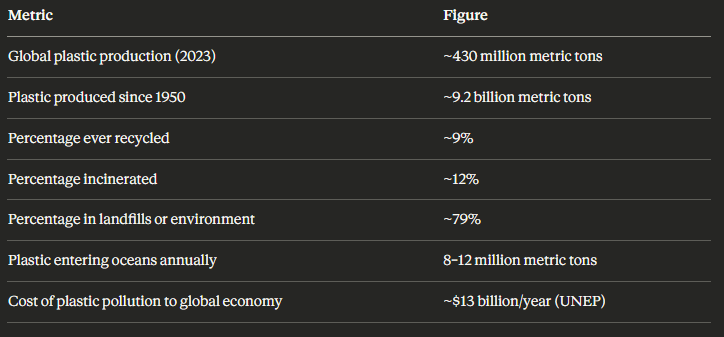
The recycling rate of 9% is not a typo. For all the blue bins and sorting facilities, the overwhelming majority of plastic ever made is still sitting in a landfill, floating in a gyre, or embedded in a food chain somewhere.
And the carbon footprint? Manufacturing plastics is emissions-intensive. The global plastics industry emits approximately 1.8 billion metric tons of CO₂-equivalent per year — roughly the same as the entire aviation industry. If plastics were a country, they'd be one of the top ten greenhouse gas emitters on Earth. Most projections show plastics emissions tripling by 2060 if nothing changes.
This is not a waste management problem. It's a materials infrastructure problem.
Part 3: What Are Bio-Plastics — And Are They the Answer?
"Bio-plastic" is a broad term that gets misused constantly. Let's define it properly.
Bio-plastics fall into two categories:
1. Bio-based plastics — made from biological feedstocks (corn starch, sugarcane, cassava, cellulose) rather than petroleum, but not necessarily biodegradable. Examples: bio-PET, bio-PE. These are chemically identical to petroleum plastics; they just have a plant-based origin. They don't biodegrade. They still fragment into microplastics.
2. Biodegradable plastics — designed to break down, but not all of them are bio-based. Some biodegradable plastics still use petroleum inputs. PLA (polylactic acid), made from fermented corn sugar, is the most common truly bio-based AND biodegradable option.
The real-world problems with most bio-plastics:
Industrial composting required. Most bio-plastics labeled "compostable" will only break down in industrial composting facilities at high temperatures. Thrown in a backyard pile, landfill, or ocean, they behave almost identically to conventional plastic.
Food crop competition. Most bio-plastics currently depend on corn or sugarcane — row crops that require significant land, water, fertilizer, and pesticide inputs. Scaling bio-plastics on corn is trading one problem for another.
Incomplete carbon story. Even if a bio-plastic breaks down, the carbon released during decomposition often negates the sequestration benefit of growing the feedstock. The net carbon math rarely pencils out cleanly.
Processing infrastructure is mismatched. Current recycling and waste streams aren't designed for bio-plastics. Mixing PLA with conventional PET plastic contaminates the recycling stream. The infrastructure for collecting and composting bio-plastics industrially barely exists.
The global bio-plastics market is currently valued at approximately $12–15 billion and projected to reach $30–40 billion by 2030. Growth is real. But the feedstock and end-of-life problems remain largely unsolved.
Most bio-plastics being sold today are, bluntly, a marketing upgrade on a structural problem. They shift the feedstock away from petroleum but don't fundamentally change the materials story.
Part 4: Hemp — The Bio-Material That Actually Changes the Equation
Here's where we get to work.
Industrial hemp (Cannabis sativa L.) is not a new material. Humans have been using it for textiles, rope, paper, and structural materials for over 10,000 years. It was displaced by petroleum, synthetic fibers, and industrial policy — not because something better came along, but because fossil fuels were cheaper when you didn't account for the externalities.
Now we're accounting for the externalities. And the math looks completely different.
Hemp as a bioplastic feedstock is categorically different from corn or sugarcane:
Feedstock superiority:
Hemp grows to harvest in 90–120 days, compared to years for timber and multiple seasons for most crops
Hemp requires no pesticides or herbicides — it's naturally pest-resistant and outcompetes weeds
Hemp requires 50–70% less water than cotton and far less than most row crops
Hemp actively rebuilds soil rather than depleting it, making it compatible with regenerative agriculture
Hemp produces two primary structural inputs from a single stalk — bast fiber (outer layer) and hurd (inner woody core) — plus seed, leaves, and biochar from residuals. Every part of the plant is usable.
The materials science of hemp-based bioplastics:
Hemp hurd is approximately 40% cellulose by weight — one of the highest cellulose concentrations of any agricultural crop. Cellulose is the backbone of most bio-plastic and composite manufacturing.
Hemp fiber and hurd can be used to produce:
Hemp cellulose plastics — replacing petroleum polymers in film, packaging, and molded products
Hemp fiber-reinforced composites — replacing fiberglass, carbon fiber, and conventional plastic composites in automotive panels, construction materials, and industrial components
Hempcrete — a carbon-negative structural material combining hemp hurd with lime binders, used in walls, insulation, and foundations
Molded fiber packaging — replacing polystyrene (styrofoam) and clamshell packaging in food service and shipping
Biochar — when hemp residuals are pyrolyzed, the resulting biochar permanently sequesters carbon while functioning as a soil amendment, water filter, and industrial additive
The carbon math is fundamentally different with hemp:
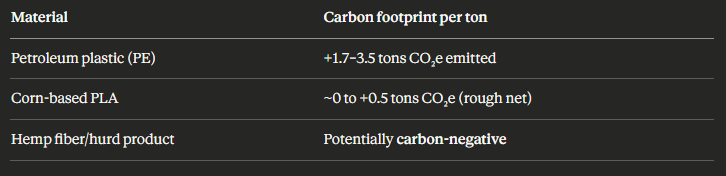
When hemp fiber or hurd is processed into a durable product — a building panel, a composite automotive component, a hempcrete wall — the carbon absorbed by the plant during growth is locked into that product for the life of the product. A hempcrete wall built today stores that carbon for 50–100+ years. That's not a carbon offset. That's a carbon sink embedded in the built environment.
This is what IHPA calls durable carbon sequestration. It's the difference between a project-based offset (plant a tree, hope it doesn't burn) and a materials-based sequestration model that locks CO₂ into physical infrastructure that lasts generations.
Part 5: The Market Opportunity — And Why Infrastructure Is the Missing Piece
The numbers are significant.
The global plastics market: $600B+ The bio-based materials market: $30–40B by 2030 The sustainable packaging market: $440B by 2030 The green building materials market: $650B+ by 2027
Hemp-derived materials can penetrate every one of these markets — fiber composites into automotive and construction, hurd into packaging and hempcrete, cellulose into bioplastics, biochar into materials science and soil markets.
So why isn't it already happening?
Because the processing infrastructure doesn't exist at scale in the United States.
Growing hemp is legal. Buying hemp products is legal. The market demand is documented. But between the field and the finished product, there is a missing link: industrial-scale decortication, fiber separation, hurd processing, and biochar production — all under one roof, with the logistics, quality controls, and offtake relationships to serve real industrial buyers.
That is exactly what Industrial Hemp Processing of America (IHPA) is building at the Kaiser Mead brownfield site in Mead, Washington — Washington State's first vertically integrated hemp processing facility. We are turning a contaminated industrial site into a carbon-negative materials hub, creating high-wage rural jobs, and building the supply chain that connects Pacific Northwest hemp farmers directly to industrial buyers.
Our product stack — fiber, hurd, biochar (NatureFlux™), certified seed, and advanced carbon materials (AuraLux™) — is designed to feed directly into the bio-materials market that is replacing petroleum plastic across every major industry category.
The Bottom Line
Petroleum plastic is not a convenience. It's a 70-year infrastructure bet on a fossil fuel input that is poisoning the food chain, warming the atmosphere, and outlasting every civilization that produced it.
Bio-plastics were a partial answer — but most of them are a feedstock swap, not a systems change.
Hemp is a systems change.
It sequesters carbon as it grows. It rebuilds soil. It produces multiple high-value industrial outputs from a single crop. And when processed into durable materials, it locks that carbon out of the atmosphere for the lifetime of the product.
The plastic economy was built on cheap fossil fuel infrastructure. The hemp economy will be built on processing infrastructure. And that infrastructure is being built right now — in Washington State, in a former Superfund site, by a company that believes the atmosphere is the most valuable resource we have.
